
![Item #19 The Lusiad, or Portugals Historicall Poem[...]. Luis de Camõens, Richard Fanshaw.](https://biblioctopus.cdn.bibliopolis.com/pictures/19.jpg?width=768&height=1000&fit=bounds&auto=webp&v=1703747165)
![The Lusiad, or Portugals Historicall Poem[...]](https://biblioctopus.cdn.bibliopolis.com/pictures/19_2.jpg?auto=webp&v=1703747165)
![The Lusiad, or Portugals Historicall Poem[...]](https://biblioctopus.cdn.bibliopolis.com/pictures/19_3.jpg?auto=webp&v=1703747165)
![The Lusiad, or Portugals Historicall Poem[...]](https://biblioctopus.cdn.bibliopolis.com/pictures/19_4.jpg?auto=webp&v=1703747165)
![The Lusiad, or Portugals Historicall Poem[...]](https://biblioctopus.cdn.bibliopolis.com/pictures/19_5.jpg?auto=webp&v=1703747165)
![The Lusiad, or Portugals Historicall Poem[...]](https://biblioctopus.cdn.bibliopolis.com/pictures/19_6.jpg?auto=webp&v=1770078004)
The Lusiad, or Portugals Historicall Poem[...]
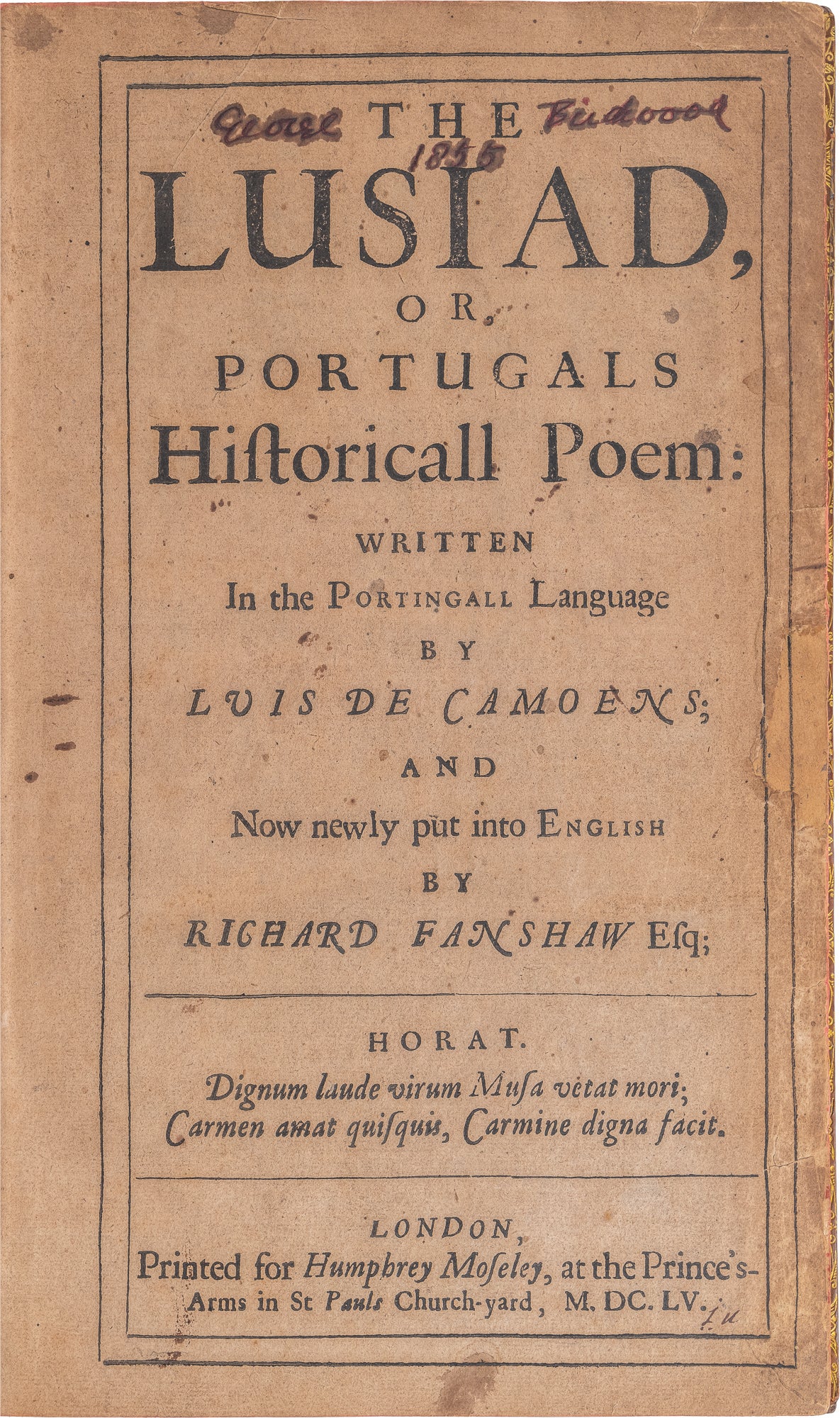
London: Humphrey Moseley, 1655. First edition in English (the Portuguese 1st was 1572). 19th century full calf, spine base chipped, top and joints strengthened, frontispiece and title darkened, as are the text margins, some stains, spots, and marginal tears, frontispiece of de Camõens neatly mounted, 1/4” chip from its upper corner, small chip from the title page’s fore margin repaired, else good (6 1/2” X 10 7/8”), and we’re being fussier here than is usual with a 361 year old book. Not really a rare edition, but an undying one. With the large portraits of Henry the Navigator and Vasco de Gama neatly folded at the borders, not trimmed, to fit. Ex–George C. M. Birdwood, his name on the title page, occasional near-contemporary notes in the text, Birdwood (late 19th century) has copious notes on the the rear binder’s blank—his favorite symbol in a few places too. Coll: 4to. [xxii], 224 pages. Ref: Pforzheimer 362. good. Item #19
"The Lusiads" stands as Portugal's quintessential national epic, immortalizing the voyages of Vasco da Gama and Portugal's maritime achievements during the Age of Discovery. This masterful work, structured in ten cantos of classical ottava rima, skillfully interweaves historical narrative with mythology, presenting Portuguese explorers as modern Argonauts guided by a pantheon of Greek deities who debate the fate of these bold voyagers. Despite its literary brilliance and cultural significance—comparable to Virgil's "Aeneid" for Rome or Homer's works for ancient Greece—"The Lusiads" remains unjustifiably overlooked in the Western canon, rarely included in comparative literature curricula outside Portugal and often overshadowed by contemporaneous works like Tasso's "Jerusalem Delivered" or Ariosto's "Orlando Furioso," despite Camões' innovative fusion of Renaissance humanism with maritime adventure and his eloquent celebration of human achievement against the backdrop of an expanding world.
In its contemporary context, "The Lusiads" served as both a celebration of Portugal's golden age of exploration and a subtle warning against imperial overreach, with Camões—himself a soldier who had traveled to India and witnessed firsthand the realities of Portuguese expansion—offering critical reflections on the moral complexities of conquest while still glorifying national achievement. The epic appeared at a pivotal moment in 1572, as Portugal's dominance was beginning to wane and just eight years before the country would lose its independence to Spain in the Iberian Union, making the work not merely a commemoration of past glories but a poignant assertion of Portuguese identity at a time of incipient national crisis. Camões' epic thus functioned both as a monument to Portugal's historic achievements and as a complex meditation on empire, faith, and the human drive for discovery that resonated deeply with readers navigating the profound social and political transformations of the late Renaissance period.
Price:
$2,250.00