
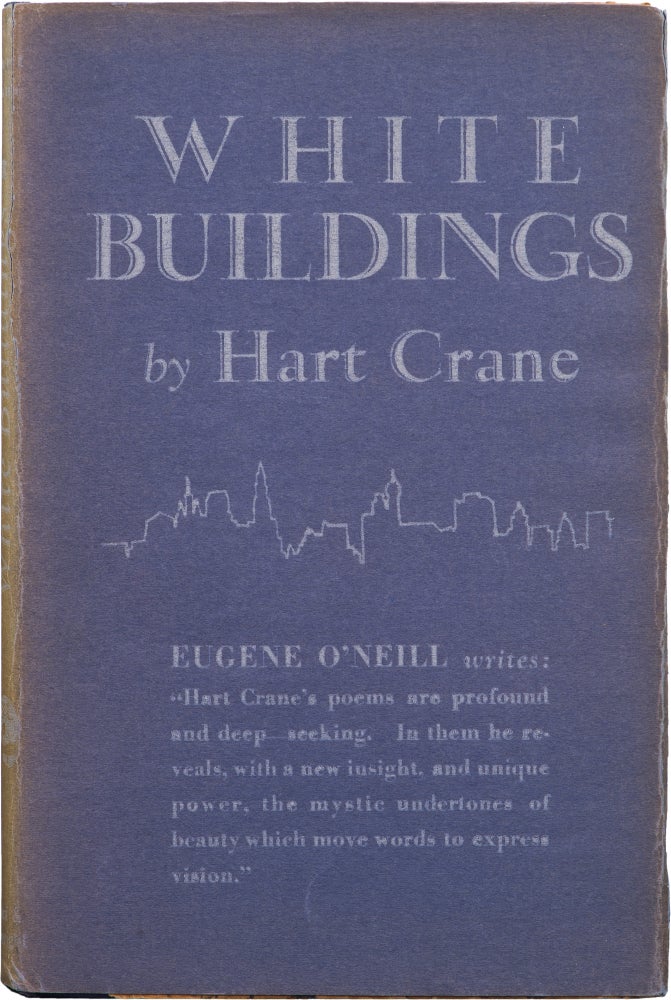
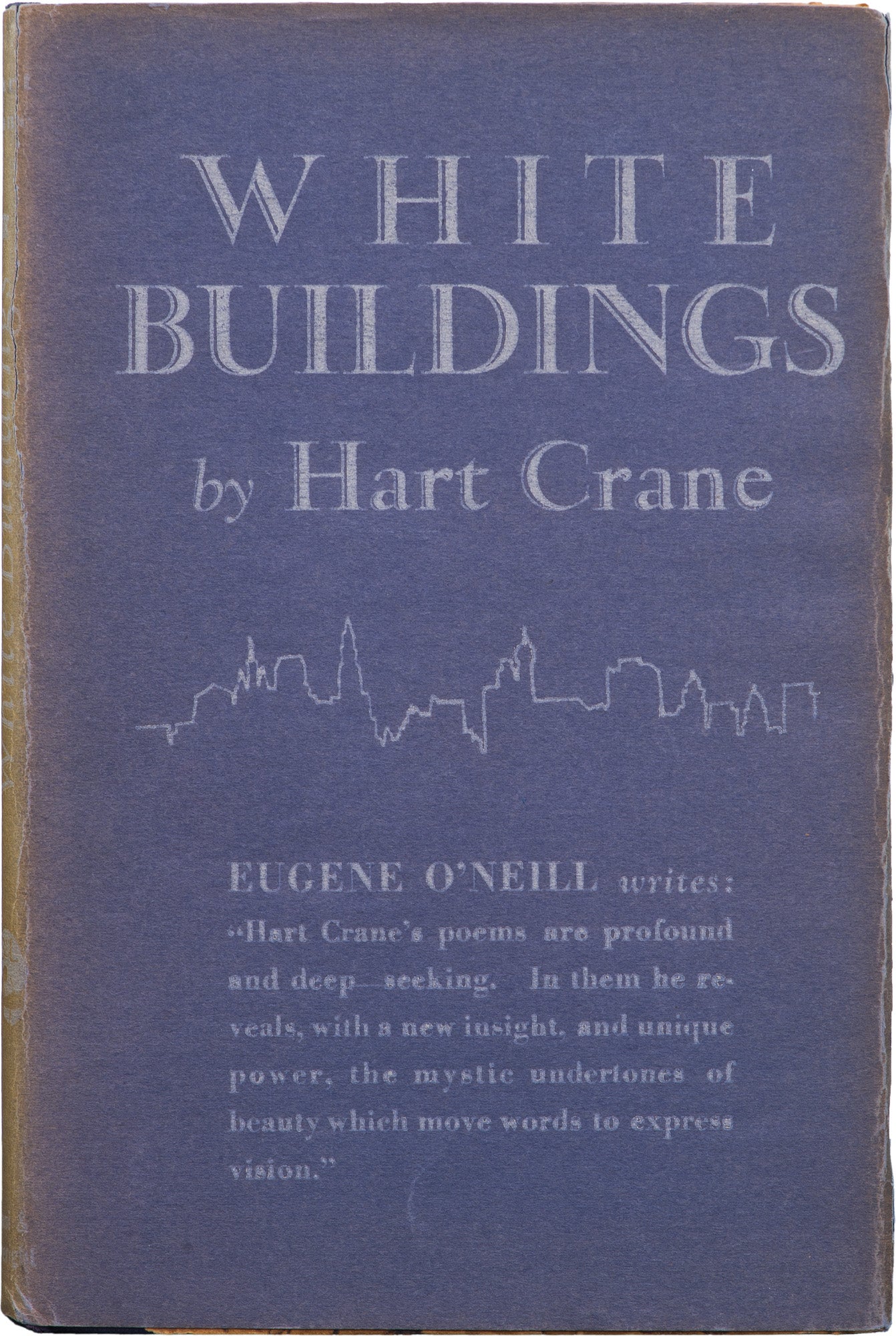
White Buildings
New York: Boni and Liveright, 1926. First Edition. The title page is a cancel, with Allen Tate’s name (who wrote the Foreword) spelled correctly. One of Crane’s own copies of his first book (the only one that’s ever surfaced, and the only one that’s likely to) with his bookplate and his ownership signature (in ink) “Hart Crane, Aug ‘31” (he drowned in 1932). This copy should not be confused with 1st editions that just have his bookplate for evidence of ownership, as his family (with all the integrity of hyenas) sold bookplates after his death. Fine in a beautiful dustjacket with the spine faded half a shade else fine condition, quality that parts the clouds to let the Sun shine down, and quite a rare jacket in such condition. Since the title page was canceled immediately, Crane logically opted for author’s copies with his friend Tate’s name spelled properly. Heavy. Singular. Best copy in the world, so far. Item #92
Hart Crane's first poetry collection, White Buildings, published in 1926, helped establish him as a leading voice in modernist poetry. The book showcases Crane's innovative style, marked by dense imagery, complex metaphors, and a non-linear, fragmented structure that evokes the rhythms of jazz and the disorienting experience of modern urban life. Poems like "For the Marriage of Faustus and Helen" and "Voyages" display Crane's signature synthesis of classical mythology and contemporary urban scenery, casting the New York cityscape as a dreamlike realm where ancient archetypes intermingle with subways, skyscrapers, and bridges.
In "At Melville's Tomb," Hart Crane constructs a complex metaphysical meditation that exemplifies his modernist poetics while engaging with the American literary tradition through the figure of Herman Melville. The poem's dense imagistic patterns reflect Crane's commitment to what he termed "the logic of metaphor"—an associative rather than linear discursive structure that seeks to crystallize emotional and intellectual complexities into condensed linguistic expressions. Crane's syntax deliberately frustrates straightforward semantic interpretation, forcing readers into active participation with the text's meaning-making processes. The opening stanza's declaration that "Often beneath the wave, wide from this ledge / The dice of drowned men's bones he saw bequeath / An embassy" establishes the central tension between material dissolution (the bones) and transcendent communication (the embassy), illustrating Crane's characteristic fusion of concrete imagery with abstract metaphysical concerns.
The poem's richly textured marine imagery functions as more than decorative metaphor; it operates as a sustained symbolic system that explores the relationship between artistic creation and death. Crane's handling of the nautical lexicon transforms Melville's oceanic obsessions into a metaphor for poetic consciousness itself, where "multitudinous seas" become the repository of cultural memory and artistic inheritance. The final stanza's proclamation that "Compass, quadrant and sextant contrive / No farther tides" suggests the limitations of rational epistemologies when confronted with the sublime, yet the poem concludes with the paradoxical assertion that even "silent answers" may "stock the sand," implying that absence itself can generate meaning. This dialectic between presence and absence, between the expressible and the inexpressible, positions Crane's work as a crucial bridge between symbolist poetics and high modernism, anticipating the linguistic preoccupations of postmodern poetry while remaining grounded in the metaphysical concerns of the American transcendentalist tradition.
Price: $75,000.00